Refraction of light: why does a spoon look broken in water?
17.11.20262 min read
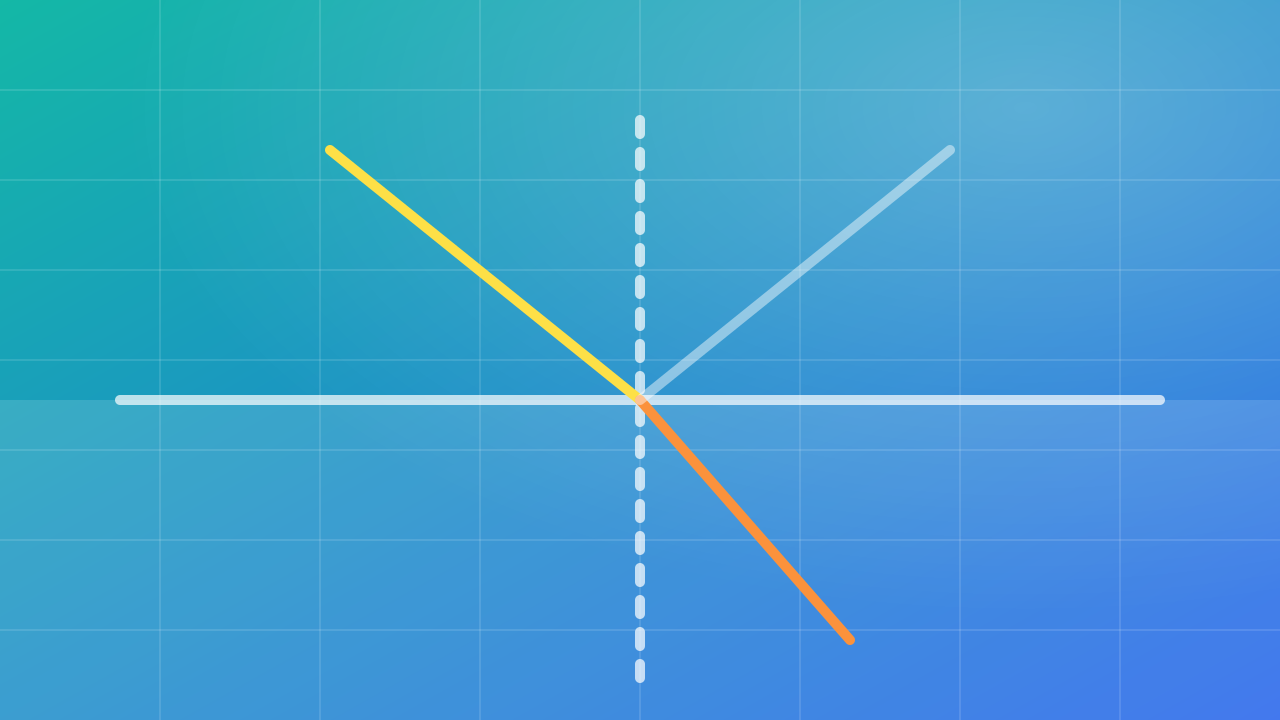
If you put a spoon into a glass of water, it looks “broken” at the water level. This is not an optical illusion but the phenomenon of refraction of light at the boundary of two media.
Why does light refract?
The speed of light depends on the medium: in a vacuum c ≈ 3·10⁸ m/s, and in water it is about 1.33 times slower. When a ray hits the boundary at an angle, one side of it slows down first and the ray changes direction — like a cart that turns when it drives from asphalt into sand at a slant.
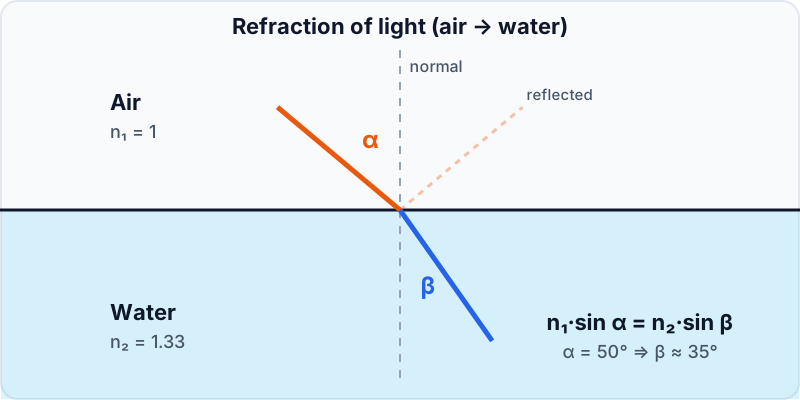
Snell’s law
n₁·sin α = n₂·sin β, where n is the refractive index of the medium:
| Medium | n |
|---|---|
| Vacuum / air | 1.00 |
| Water | 1.33 |
| Glass | ≈ 1.5 |
| Diamond | 2.42 |
Rule: when passing into a denser medium (larger n) the ray bends toward the normal, and when passing into a less dense one it bends away from it.
Example
A ray fell from air onto water at an angle α = 50°. sin β = sin 50° / 1.33 = 0.766 / 1.33 ≈ 0.576, so β ≈ 35°.
In everyday life
- The bottom of a pool looks shallower than it really is;
- Lenses and glasses refract and focus light;
- A rainbow is the result of refraction and reflection of light in raindrops;
- Fibre-optic internet is based on total internal reflection.
Check the law yourself in the virtual laboratory by changing the angles, then continue the Optics course.
Comments 0
Sign in to leave a comment.
- No comments yet. Be the first!