The current law in practice: a simple experiment
17.11.20261 min read

The current law (Ohm’s law) I = U / R is the most important law of electric circuits. It has three quantities: current I (ampere), voltage U (volt) and resistance R (ohm).
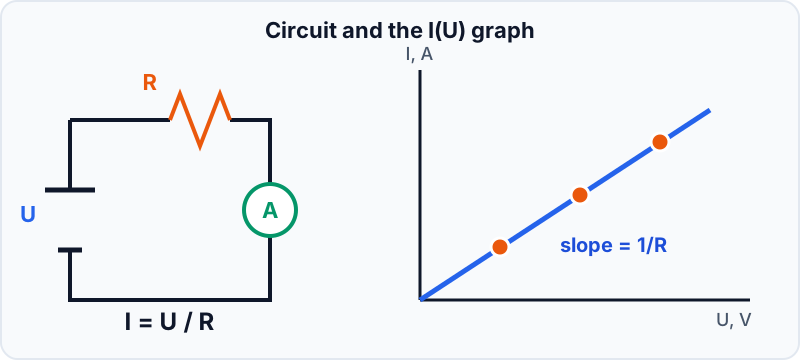
Experiment: in the virtual laboratory
Check the law in the virtual laboratory:
- Keep
Rat 20 Ω and changeUto 2, 4, 6, … V; - Write down
Iat every value; - You will see that the
I(U)graph is a straight line whose slope equals1/R.
| U, V | R, Ω | I, A (expected) |
|---|---|---|
| 2 | 20 | 0.10 |
| 4 | 20 | 0.20 |
| 6 | 20 | 0.30 |
| 8 | 20 | 0.40 |
Conclusion
If the voltage doubles, the current also doubles (with the resistance unchanged). If the resistance doubles, the current halves.
Remember
- An ammeter is connected to the circuit in series, a voltmeter in parallel.
- The formula can be written in three ways:
I = U/R,U = I·R,R = U/I. - Power:
P = U·I = I²·R. A kettle drawing 2 A at 220 V has a power of 440 W.
Safety: in a real experiment do not work with voltages above 36 V without a teacher’s supervision.
More: the Electric current and the current law course.
Comments 0
Sign in to leave a comment.
- No comments yet. Be the first!