Velocity, acceleration and distance: a table of formulas
17.11.20262 min read

Kinematics is the branch that studies motion without taking its causes (forces) into account. The main quantities are distance s, velocity v, acceleration a and time t.
Main formulas
| Type of motion | Velocity | Distance |
|---|---|---|
| Uniform | v = const | s = v·t |
| Uniformly accelerated | v = v₀ + a·t | s = v₀·t + a·t²/2 |
| Timeless | v² − v₀² = 2·a·s | |
Note: acceleration is taken with a “+” sign when the speed increases and “−” when it decreases.
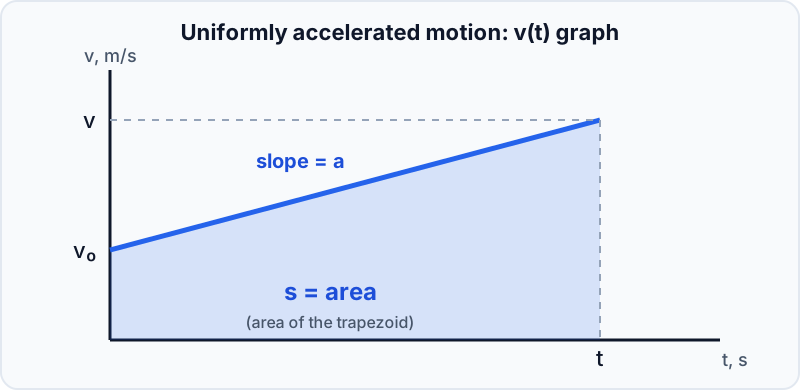
How does the formula come from the graph?
In uniformly accelerated motion the speed grows along a straight line with time. The slope of the graph equals the acceleration a, and the area under the line equals the distance covered s.
A sample problem
A car moved for 5 s with an acceleration of 2 m/s², starting from a speed of 10 m/s. Find the distance.
- Given:
v₀ = 10 m/s,a = 2 m/s²,t = 5 s. - Formula:
s = v₀·t + a·t²/2. - Calculation:
s = 10·5 + 2·25/2 = 50 + 25 = 75 m. - Check: the final speed is
v = 10 + 2·5 = 20 m/s; the average speed is 15 m/s,15·5 = 75 m✔.
The most common mistakes
- Mixing up km/h and m/s:
1 m/s = 3.6 km/h. - Keeping the “+” sign of acceleration when braking.
- Using
s = v·twhen the time is not given — here you needv² − v₀² = 2·a·s.
To consolidate the topic, take the Kinematics course and its tests.
Comments 1
Sign in to leave a comment.
- I
Islom Karimov17 November 2026
Zo'r