Newton’s laws in everyday life
17.11.20262 min read

Newton’s three laws are the foundation of mechanics. They are much easier to understand through a bus, a lift and a football than from a book.
1st law: inertia
If no force acts on a body (or the forces are balanced), it keeps its state of rest or uniform motion. That is why you are thrown forward when a bus brakes sharply: your body “wants” to keep moving.
2nd law: force and acceleration
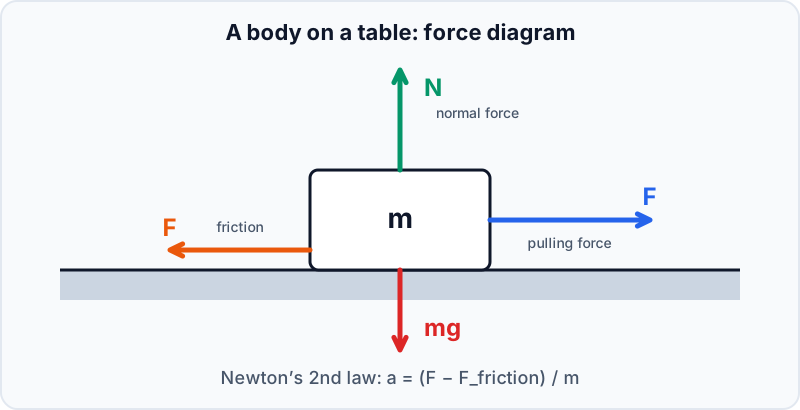
a = F / m or F = m·a. With the same force you speed up a light cart quickly and a heavy one slowly. In a problem, first draw all the forces and find the net force.
3rd law: action and reaction
Bodies act on each other with forces equal in magnitude and opposite in direction. When a swimmer pushes off the wall, the wall pushes the swimmer too; a rocket throws gas backwards and flies forward. The important point: these forces are applied to different bodies, so they do not cancel each other.
A short table
| Law | Content | Example |
|---|---|---|
| 1st law | F = 0 ⇒ v = const | Leaning forward when a bus brakes |
| 2nd law | F = m·a | A truck accelerates more slowly than a car |
| 3rd law | F₁₂ = −F₂₁ | The flight of a rocket |
Exercise
A horizontal force of 10 N is applied to a body of mass 2 kg, and the friction force is 4 N. Find the acceleration.
a = (F − F_friction)/m = (10 − 4)/2 = 3 m/s².
To study the topic in depth, go to the Dynamics course.
Comments 0
Sign in to leave a comment.
- No comments yet. Be the first!