Three ways of heat transfer: conduction, convection, radiation
17.11.20261 min read
Hot tea slowly cools down, the handle of a pot gets hot, and the Sun warms us from 150 million km away. All of this is heat transfer, but in different ways.
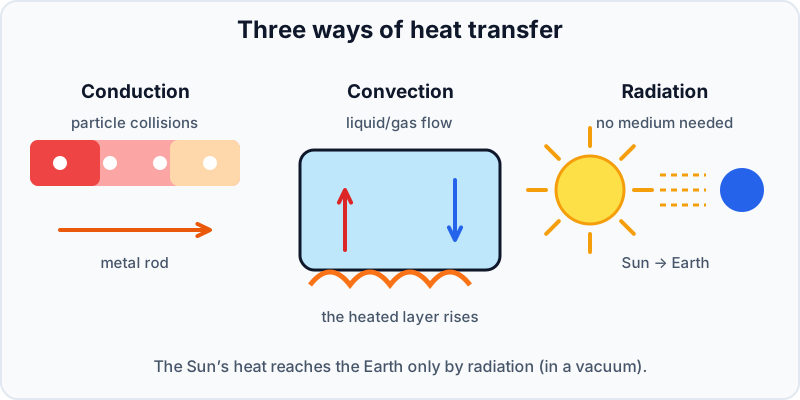
1. Conduction
Heated particles vibrate faster and pass energy to their neighbours. The substance does not move — the energy does. Metals conduct heat well; wood, foam and air conduct it poorly. That is why pot handles are made of wood and winter clothes of fibres filled with air.
2. Convection
In liquids and gases the heated layer expands, becomes lighter and rises, while the cold layer sinks. A circular flow appears. This is exactly how a radiator heats the air of a room; wind and the sea breeze are also results of convection.
3. Radiation
Every body emits infrared radiation. This way needs no medium, which is why the Sun’s energy reaches the Earth through empty space. Dark bodies absorb and emit radiation well, while light, shiny ones reflect it — that is why we wear white clothes in summer.
Comparison
| Way | Where? | Does the substance move? | Example |
|---|---|---|---|
| Conduction | mostly solids | no | the handle of a spoon getting hot |
| Convection | liquid, gas | yes | water boiling in a kettle |
| Radiation | everywhere, even in a vacuum | no | sunlight, a campfire |
How does a thermos work?
A thermos reduces all three ways: the air between its walls is pumped out (no conduction or convection), and the inner surface is silvery (radiation is reflected).
Study the topic in more depth in the Thermodynamics course.
Comments 0
Sign in to leave a comment.
- No comments yet. Be the first!