How to study physics: 5 tips
17.11.20262 min read

Physics is a subject of understanding, not memorising. Many students learn formulas by heart and get lost when a problem changes even slightly. The five habits below noticeably improve results.
1. Picture the phenomenon first
Before reaching for a formula, draw a diagram: which forces act, where is the body moving, what stays constant? A correct diagram solves half of the problem.
2. Write down the units
If every quantity has its unit next to it, half of the mistakes find themselves. For example, velocity is m/s, acceleration m/s², force N = kg·m/s². If the unit of your answer does not match the expected one, there is a mistake in the formula.
3. Learn to derive the formula
A memorised formula is forgotten; an understood one stays. Try to get s = v₀·t + a·t²/2 as the area under the v(t) graph — there is a separate article about it.
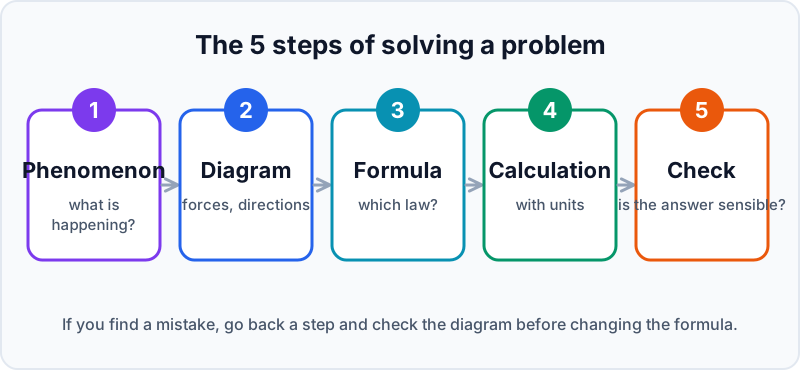
4. Two or three problems every day
Two or three problems every day work better than 15 problems once a week: the brain moves information into long-term memory through repetition. Write the problems you got wrong in a separate notebook and solve them again a week later.
5. Run experiments
In the site’s virtual laboratories change a parameter and watch the result: why does the stopping distance become four times longer when the speed doubles? An answer you find yourself is remembered for life.
Note: do not leave what you did not understand “for later”. Physics is like a chain — if one link breaks, the next ones do not work.
To begin, watch the first lesson of the Kinematics course.
Comments 0
Sign in to leave a comment.
- No comments yet. Be the first!