Free fall and a body thrown at an angle
17.11.20262 min read
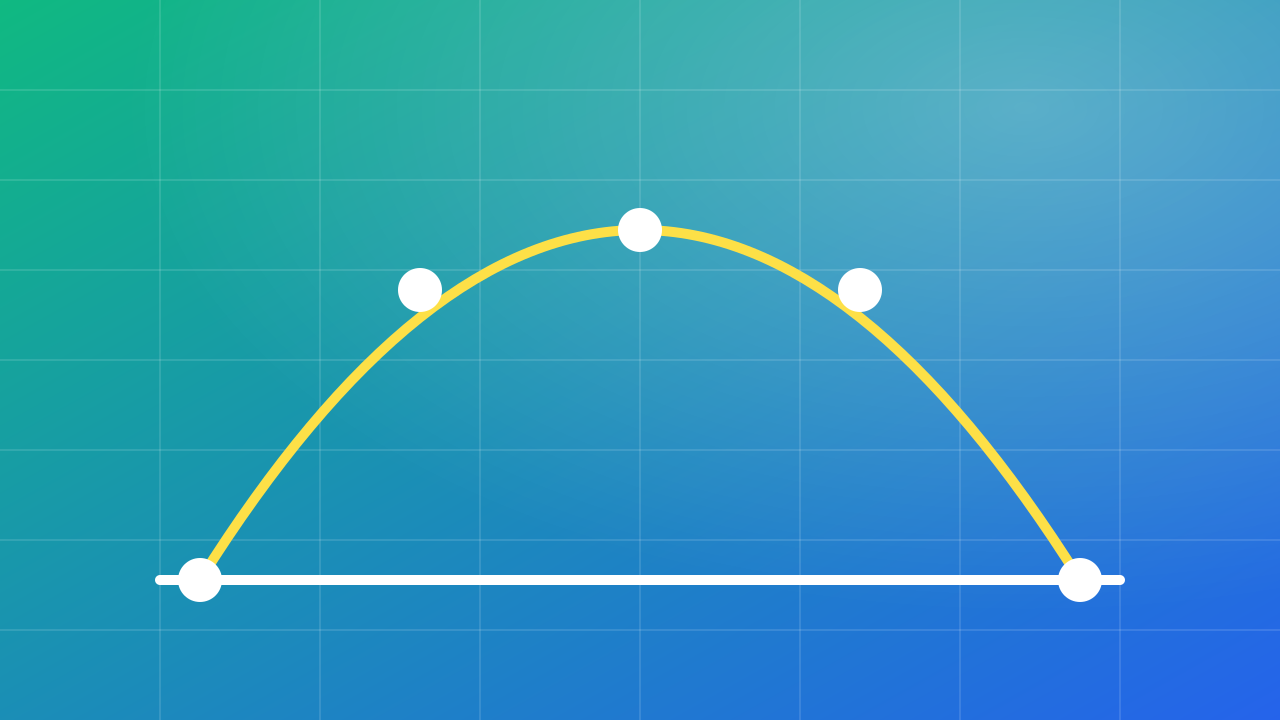
When a footballer sends the ball high, an athlete throws a discus or water splashes in a fountain, the body draws a parabola. The secret of this motion is simple: it can be split into two independent motions.
Free fall
Neglecting air resistance, all bodies fall with the same acceleration: g ≈ 9.8 m/s² (problems often use 10 m/s²). A heavy and a light body reach the ground at the same time — Galileo discovered this, and on the Moon an astronaut showed it by dropping a feather and a hammer.
- Velocity:
v = g·t - Height:
h = g·t²/2 - Time of fall:
t = √(2h/g)
A body thrown at an angle
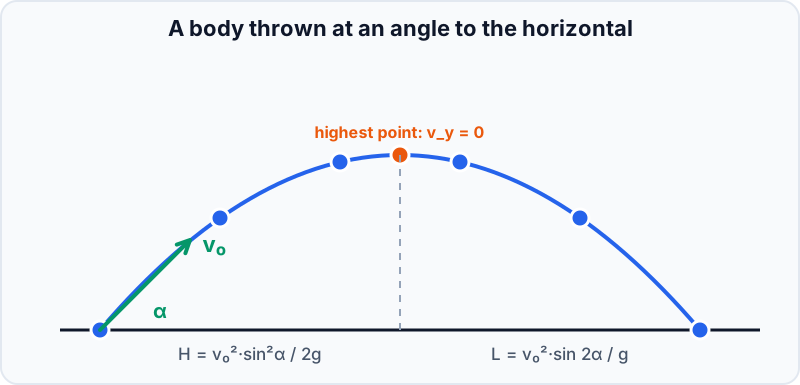
Let the initial velocity v₀ make an angle α with the horizontal. We split it into two components:
- Horizontal:
v_x = v₀·cos α— constant (uniform motion); - Vertical:
v_y = v₀·sin α − g·t— slows down like a body thrown upward.
Important results
| Quantity | Formula |
|---|---|
| Time of ascent | t = v₀·sin α / g |
| Maximum height | H = v₀²·sin²α / (2g) |
| Range | L = v₀²·sin 2α / g |
The range is largest at α = 45° because sin 90° = 1. The angles 30° and 60° give the same range.
Problem
A stone is thrown at 20 m/s at an angle of 30° (g = 10 m/s²). Maximum height: H = 400·0.25 / 20 = 5 m. Range: L = 400·sin 60° / 10 ≈ 34.6 m.
Try changing the angle again in the projectile laboratory.
Comments 0
Sign in to leave a comment.
- No comments yet. Be the first!