Pressure and the Archimedes force: why does a ship not sink?
17.11.20261 min read

A steel coin sinks in water, yet a steel ship weighing a hundred thousand tonnes floats. The reason is the Archimedes force.
Pressure
Pressure is force divided by area: p = F / S (unit: pascal, 1 Pa = 1 N/m²). That is why the sharp side of a knife cuts well (small area — large pressure), and walking on snow with skis is easy (large area — small pressure).
Inside a liquid the pressure grows with depth: p = ρ·g·h. That is why the base of a dam is built thick and a diver feels a large pressure at depth.
The Archimedes force
A body immersed in a liquid is acted on by an upward buoyant force equal to the weight of the liquid displaced by the body:
F_A = ρ·g·V
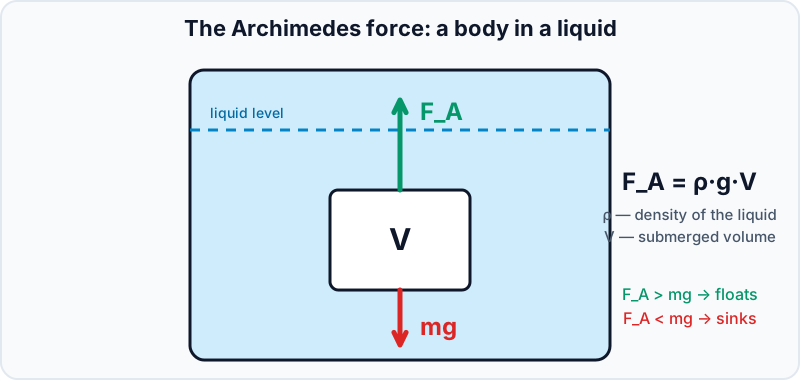
When does a body float?
| Condition | Result |
|---|---|
| ρbody < ρliquid | floats (partly submerged) |
| ρbody = ρliquid | in equilibrium inside the liquid |
| ρbody > ρliquid | sinks |
Why does a ship not sink?
A ship is hollow inside, so its average density is lower than that of water. It sinks in just far enough that the weight of the displaced water equals the weight of the ship.
Problem
A body of volume 0.002 m³ is fully immersed in water. F_A = 1000·10·0.002 = 20 N. If the weight of the body is 15 N, it floats up; if 25 N, it sinks.
Comments 0
Sign in to leave a comment.
- No comments yet. Be the first!